AUTONOMOUS SERVICE PROVISIONING AND SELF-HEALING IN MULTI-BAND MULTI-DOMAIN IPOWDM NETWORKS FOR LIVE VIDEO TRAFFIC
HHI,CNIT,CTTC,ELIG,TIM.PLF,OLC-E and UPC
The growing demand for high-bandwidth and low-latency services, such as video streaming and beyond 5G, requires networks that efficiently manage diverse traffic across access, metro, and core domains. Traditional segmented architectures fall short, driving the need for unified, scalable solutions. Multi-band optical networks, leveraging S, C, and L bands with IP over Wavelength-division multiplexing (IPoWDM) technologies, address these challenges by optimizing resource use and reducing latency. While unified orchestration across multiple domains and bands has been explored, many efforts remain confined to limited domains or virtual environments rather than real hardware implementations. A significant gap persists in large-scale, real-world deployments that fully integrate WDM and IP traffic into a unified IPoWDM system capable of autonomous service provisioning across domains and bands.
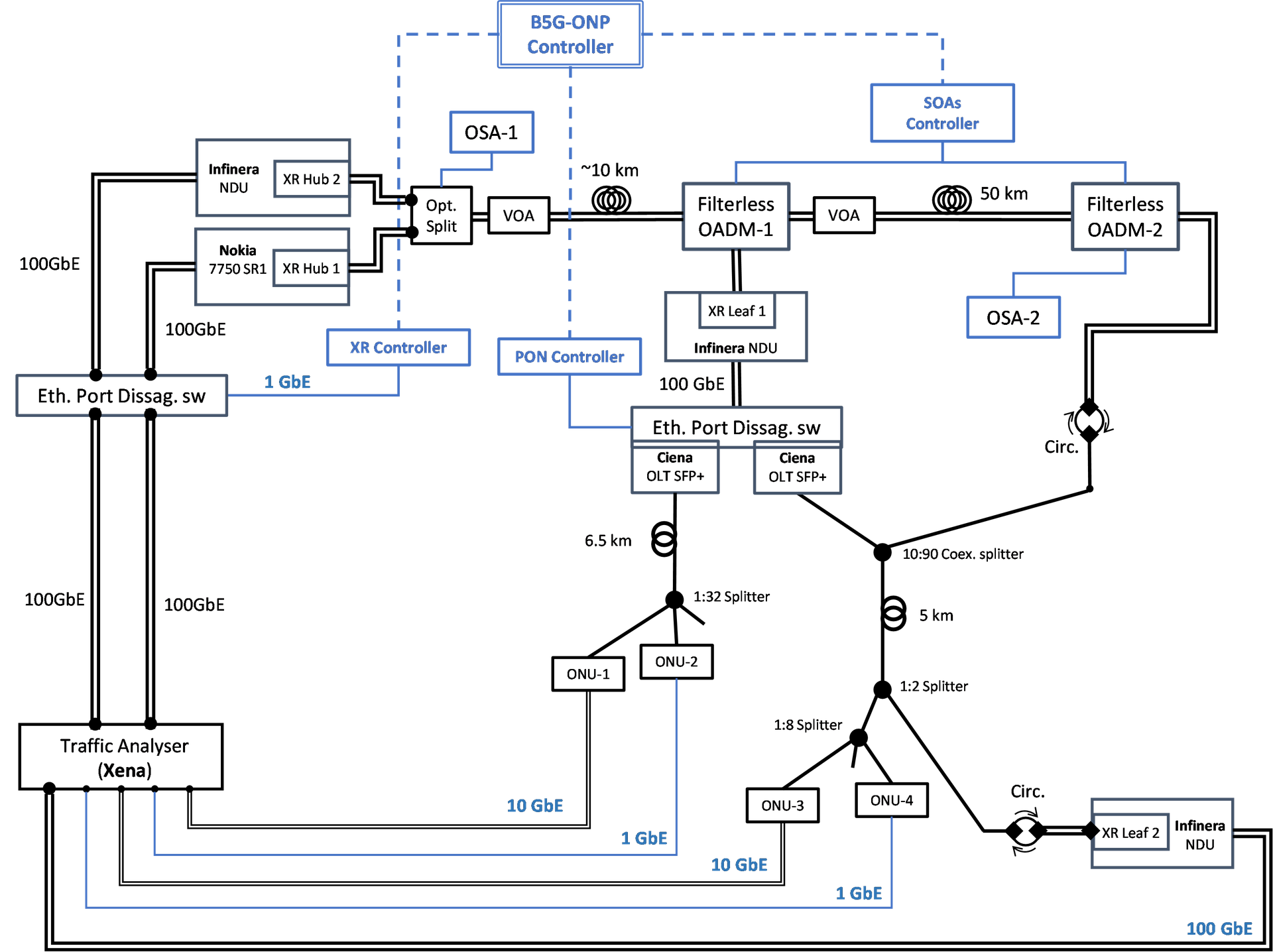
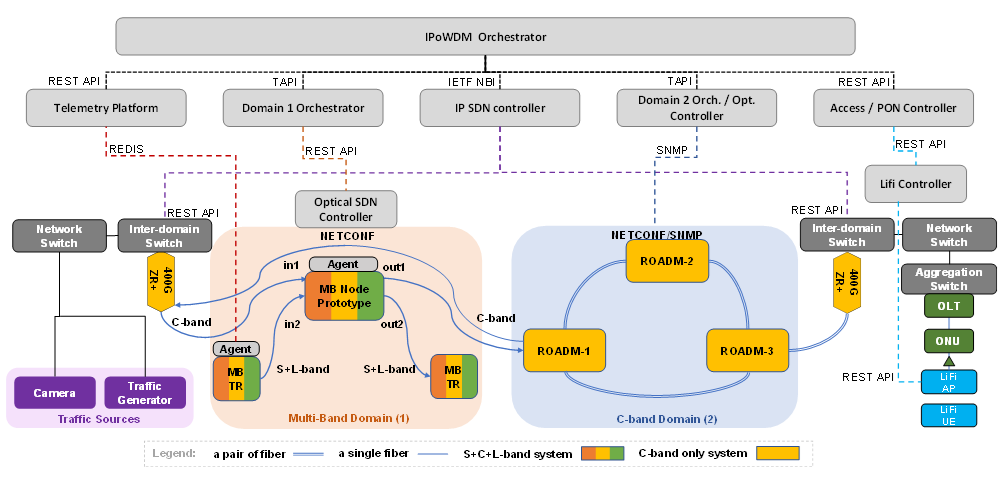
This work summarizes a large-scale integration of control and data plane technologies within a multi-band, multi-domain IPoWDM network, unifying commercial WDM systems, IPoWDM pluggables, and novel multi-band components for fully autonomous service provisioning across access, metro, and core network segments. Our approach supports both parallel and sequential provisioning, enabling the network to adapt to varying demands and optimize setup times. Additionally, we implement a robust self-healing mechanism that autonomously detects and mitigates network anomalies, ensuring continuous high performance and reliability. Using a hierarchy of controllers and newly developed Software defined networking (SDN) agents, we demonstrate the system's ability to operate autonomously.
To validate our approach, we conduct experiments with live traffic, including video streams from cameras, mimicking real-world network conditions. The results confirm the network's ability to autonomously provision services and adapt to dynamic demands, while maintaining high performance. Our findings reveal significant improvements in provisioning speed, network resilience, and the integration of IP and optical technologies within an end-to-end framework.