If you cannot see the newsletter properly, click here |
|
|
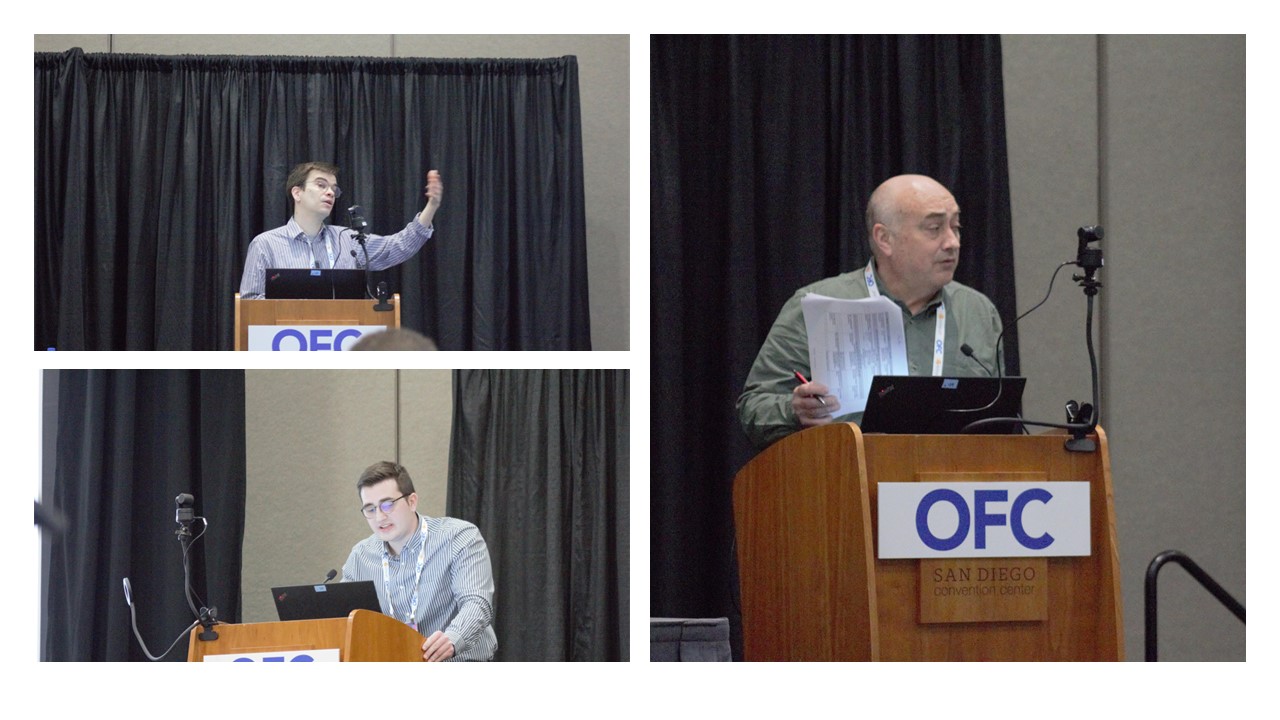
Optical Fiber Communication Conference (OFC) 2023, one of the most important events for optical communications and networking, was held in the San Diego Convention Center in San Diego, California, USA from March 5 to 9, 2023. During the event partners from the B5G-Open project presented 13 works. A brief overview is presented in this newsletter. You may visit the B5G-Open website for further details. |
|
|
“An Intelligent Optical Telemetry Architecture”
Velasco, P. Gonzalez, and M. Ruiz
It is suggested that a distributed telemetry system be used, with agents receiving and processing data before transmitting it to a management at the center. On optical constellation telemetry, intelligent data aggregation significantly lowers data rate without significantly increasing error. “P4-based Hitless FaaS Load Balancer for Packet-Optical Network Edge Continuum” I. Pelle, F. Paolucci, B. Sonkoly, and F. Cugini
P4 and innovative node telemetry are used to distribute load balancing of the ultra-low latency serverless application to several edges. It is shown how to handle an edge overload without causing an appreciable difference in latency.
“Hybrid SDN Orchestration in Multi-Layer Network with SONiC Packet-Optical Nodes and Coherent Pluggables” D. Scano, J. Ortiz, A. Giorgetti, J.M. Martínez, A. Sgambelluri, E. Riccardi, F. Cugini, and P. Pavon
This demonstration shows a thorough framework that takes use of the efficient collaboration of packet-optical nodes at the boundary between the packet and optical domains, which is controlled by the BGP and OSPF protocols and a hierarchical control architecture. The system offers soft failure recovery and controlled provisioning across a multi-layer metro network. “P4-based Telemetry Processing for Fast Soft Failure Recovery in Packet-Optical Networks”
F. Cugini, C. Natalino da Silva, D. Scano, F. Paolucci, and P. Monti The presentation of a unique framework for in-network P4 processing of distributed multi-layer telemetry data allows for the quick implementation of effective soft failure detection and recovery procedures. |
|
“Distributed Architecture Supporting Intelligent Optical Measurement Aggregation and Streaming Event Telemetry“ Gonzalez, R. Casellas, J-J Pedreno-Manresa, A. Autenrieth, F. Boitier, B. Shariati, J. Fischer, M. Ruiz, J. Comellas, and L. Velasco The demonstration of a distributed telemetry system integrating optical measurement and event data gathering. There will be demonstrations of optical spectrum measurements from Nokia Bell Labs, optical transponder measurements from ADVA, and SDN controller events from CTTC. “Degradation Detection and Severity Estimation by Exploiting an Optical Time and Frequency Digital Twin” Devigili, M. Ruiz, S. Barzegar, N. Costa, A. Napoli, J. Pedro, and L. Velasco We use a time and frequency domain digital twin's inherent advantages to identify degradations and evaluate their severity. The effectiveness of this strategy is supported by the noticeable performance shown for filter failures. “Enabling Multiband Transmission and Programmability in Disaggregated Optical Metro Networks” L. Nadal, R. Casellas, J. M. Fabrega, F. J. Vflchez, and M. Svaluto Moreolo A multi band (MB) sliceable bandwidth/bit rate variable (S-BVT) architecture is experimentally assessed over a disaggregated optical metro network. The programmability of the MB S-BVT is demonstrated by the implementation of an OpenConfig SDN agent.
“DRL for VNF placement in Inter-Data Center Elastic Optical Networks“ Hernández-Chulde, R. Casellas, R. Martínez, R. Vilalta, and R. Muñoz
The provisioning of services over a cloud/EON stratum is addressed by a unique DRL solution. The advantage of DRL is that, when compared to conventional heuristics, it may be applied to a variety of (unseen) EON topologies and achieve superior service blocking. |
|
|
Other works presented: -
“Data Augmentation to Reduce Computational Complexity of Neural-Network-Based Soft-Failure Cause Identifier”, L. Z. Khan, P. J. Freire, J. Pedro, N. Costa, A. Napoli, and N. Sambo.
- “Optimal Design of Filterless Horseshoe Networks Supporting Point-to-Multipoint Transceivers”, M. M. Hosseini, J. Pedro, N. Costa, A. Napoli, J. E. Prilepsky, and S. K. Turitsyn.
- “Clustering-based dynamic bandwidth allocation for point-to-multipoint coherent optics”, J. A. Hernández, F. Arpanaei, G. Martínez, Ó. G. de Dios, J. P. Fernández-Palacios, and A. Napoli.
- “Technical Study on the Viability of Hollow-Core and Ultra-low-loss Silica Fibres in Metro-Core Optical Network”, M. A. Iqbal, P. Wright, and A. Lord.
- “On the Impact of Fault-Induced Power Transients in Wideband Optical Networks” , A. Souza, A. Eira, N. Costa, J. Pedro, and J. Pires.
|
|
|
This project is supported by the European Union’s Horizon 2020 research and innovation programme under grant agreement No. 101016663 (B5G-OPEN) |
| Grant Agreement Number: 101016663
Status: Active
Start Date: 01 Nov 2021
Duration: 36 months
Budget: €5.465.068,75
Call ID:H2020 ICT-52-2020
Type of Action: RIA (Rersearch and Innovation Action) |
|
This project is part of 5G PPP Phase 3, Part 6: 5G innovations for verticals with third party services & Smart Connectivity beyond 5G |
|
|
|